In partnership with the Vermont Energy and Climate Action Network (VECAN), the AVCC hosted a webinar chronicling community science efforts to map, monitor and maintain stormwater infrastructure at the local level. Designed to manage water flow from streams and storms, culverts, ditches, and drains can easily become clogged with leaves, branches and other debris that diminish their mitigating impact on flooding. Properly designed and maintained culverts can also aid in habitat connectivity, prevent road washouts, mitigate soil erosion and pollutant runoff, and protect water quality. The devastating flooding events of the past few years have demonstrated the importance of keeping these often overlooked but critically important infrastructure in good working order, and grassroots volunteers have stepped up to the challenge.
Created in collaboration between the Black River Action Team, Cavendish Connects, Black River Valley Resources, the Rural Rivers Project, and Dartmouth College students, Culvert Crawlers is a community-based stormwater infrastructure monitoring program that aims to keep culverts clear and effective. Kelly Stettner, Director of the Black River Action Team, and Dr. Charis Boke, a researcher in the Anthropology Department at Dartmouth College, explain how the Culvert Crawlers came to be, how they use their mapping platform to monitor culverts, and how people can launch similar initiatives in their own towns. Learn more about the Culvert Crawlers at https://sites.dartmouth.edu/mappingforresilience/culvert-crawlers/
JoAnn Hanowski of the Greensboro Conservation Commission (GCC) addressed the successes and challenges of her town’s Adopt-a-Culvert Program, which also began as a grassroots response to the floods of 2023 and 2024. A partnership between the GCC, the Watershed Stewards of the Greensboro Association, and the national Adopt-a-Drain program, this initiative aims to clear debris from ditches and culverts on at least a biannual basis – once in the spring and again in the fall. Volunteers are directed to use the vt.adopt-a-drain.org website to “adopt” one or more of the 800 culverts throughout the Town of Greensboro. Both approaches represent a potential path forward for communities that want to be proactive in adapting to changing weather patterns.
The Vermont Introduced Species Collaborative hosted its 3rd Annual Introduced Species Collaborative Gathering on Friday, May 8th in Montpelier. This event was for anyone interested or engaged in introduced (invasive) species management to gather and learn how different organizations and volunteer groups are working to protect Vermont’s natural communities and working landscapes. It was a full day of building connections and knowledge, and we hope that our online and in-person attendees all walked away with new ideas, new energy, and new contacts that will expand and enhance their work.
The Collaborative also extends its gratitude to the event’s many speakers for the effort and care that they put into creating engaging presentations related to introduced species management. It was inspiring to see the breadth of knowledge in the room, from community level coordination of volunteers to cross agency partnerships.
3rd Annual Vermont Introduced Species Collaborative Gathering 9:00 am to 3:30 pm | Friday, May 8th 111 State Street, Room #110, Montpelier, VT 05602
The 2026 gathering featured presentations and discussions on these topics and more: ➡ Cross-agency treatment of tree of heaven with the Agency of Transportation and the Department of Forests, Parks and Recreation ➡ Mad River Knotweed Project qualitative research project with community partners ➡ A spotlight on the Aquatic Invasive Species Program ➡ State ecologist perspective on invasives management on state lands ➡ Five-minute flash presentations on species specific management strategies, partnerships, and town-level organizing
Language Conversation, Regulated Introduced Plant Species Rule Overview, and VTInvasives.org Website Updates (recording) • Emilie Inoue, Vermont Agency of Agriculture, Food and Markets • Gwen Kozlowski, UVM Extension / Vermont Department of Forests, Parks and Recreation
Mad River Valley Invasive Species and Habitat Restoration Initiative (recording) Ever wonder what it takes to grow, sustain and improve a community-based invasive species and habitat restoration initiative? Some answers are starting to emerge from a qualitative research study of the initiative in the Mad River Valley. This is a conversation among research team members and leaders of this valley-wide effort to glean early insights from the research. • Andrea Henderson, Fayston Conservation Commission • Curt Lindberg, Waitsfield Conservation Commission • Zoë Smiarowski, UVM Field Naturalist Program
A State Ecologist Perspective (recording) This presentation offers a behind-the-scenes look at how introduced invasive terrestrial plant species are managed across Vermont Agency of Natural Resources lands. It will highlight how the State Lands Ecologist, with the VT Fish & Wildlife Department, coordinates with land managers through project review, site visits, and ongoing consultation, along with collaborative efforts such as the Black Ash Workgroup and partnerships with organizations like Ruffed Grouse Society. • Danielle Owczarski, Vermont Fish and Wildlife Department
— Five Minute Flash Presentations —
Innovative and Effective Non Chemical Strategies of Ecological, Multi-Functional Riparian Forested Buffer (recording) • Jess Rubin, UVM Department of Agriculture, Landscape, and Environment / MycoEvolve
Black Ash Stewardship (recording) • Joanne Garton, Vermont Urban & Community Forestry Program
Calais Phragmites Control Project (recording) • Neal Maker, Calais Conservation Commission
Afternoon Session:
Aquatic Invasive Species Program (recording) • Kim Jensen, Vermont Department of Environmental Conservation
Lake Champlain Aquatic Invasive Species Management (recording) • Meg Modley, Lake Champlain Basin Program
— Five Minute Flash Presentations —
Controlling and Poison Parsnip in Lincoln (recording) • Tina Scharf, formerly with the Lincoln Conservation Commission
Mechanical Management of European Frogbit (recording) • Kate Kelly, Lewis Creek Association
Help Spot Spotted Lanternfly! (recording) • Ginger Nickerson, Vermont Urban & Community Forestry Program
Integrated Pest Management (recording) • Stephanie Smith, Vermont Agency of Agriculture, Food and Markets
— — —
Tree of Heaven Collaboration (recording) Bonnie and Noah will share about their collaborative management of tree-of-heaven and how the challenge of managing introduced plant pests has brought about the opportunity for greater communication and connection between their agencies. • Bonnie Donahue, Vermont Agency of Transportation • Noah Hoffman, Vermont Department of Forests, Parks and Recreation
The AVCC was pleased to see so many conservation commissioners in attendance at this year’s event, including a few presenters. The vast majority of our member commissions are actively engaged in monitoring, removal and remediation initiatives on town-owned lands, and we strongly encourage that this work continue in coordination with partner groups and neighboring CCs. Let us know what you’re working on and how we can help by emailing info@vtconservation.org.
Neal Maker (Calais CC) talks about the Calais Phragmites Control Project
Tina Scharf (formerly Lincoln CC) discusses efforts to control poison parsnip in LincolnKate Kelly (Hinesburg CC) presents the Lewis Creek Association’s work with European frogbit
Curt Lindberg (Waitsfield CC), Andrea Henderson (Fayston CC), and Zoe Smiarowski (UVM) discuss invasive species management and habitat restoration in the Mad River Valley
About the Vermont Introduced Species Collaborative: Comprised of members from the Vermont Land Trust, the Vermont Agency of Agriculture Food and Markets, the Vermont Association of Conservation Districts, and the Association of Vermont Conservation Commissions, we have joined together to build a unified and inclusive network that aims to connect all those whose work intersects with the management of introduced (invasive) species in Vermont. By fostering collaboration, trust-building, and diverse participation, we aim to ensure that all practitioners have access to accurate, timely information and an effective network of communication. This network promotes cooperation among government, landowners, industry, conservation groups, and the public to address the challenges posed by introduced species. Together, we strive for mutual gains and sustainable outcomes through a balanced approach that complements voluntary actions with the support of regulatory and state agencies.
Vernal pools are small, seasonal wetlands that flood in spring and dry up by midsummer, creating vital, fish-free nurseries for amphibians like salamanders and wood frogs. These hidden gems also provide food and water for countless forest creatures—but their small size and temporary nature make them especially vulnerable to human impacts. Join Kevin Tolan from the Vermont Center for Ecostudies (VCE) as we take a virtual step into the world of vernal pools and learn how to document and conserve these delicate ecosystems in your area.
Kevin is also touring the state with a series of field events co-hosted with local conservation commissions. If you would like to schedule an event in your town, please reach out to Kevin at ktolan@vtecostudies.org.
2026 Vernal Pools Field Tour
Norwich – Saturday, April 11th Co-hosted by the Norwich Conservation Commission and the Upper Valley Land Trust
Salisbury – Wednesday, April 22nd @ 10:00 am Co-hosted by the Salisbury and Ripton Conservation Commissions
Brattleboro – Saturday, April 25th @ 10:00 am Co-hosted by the Bonnyvale Environmental Education Center
Hartford – Sunday, April 26th @ 10:00 am Co-hosted by the Hartford Conservation CommissionandHartford Salamander Team
Hinesburg – Sunday, April 26th @ 10:00 am Co-hosted by the Hinesburg Conservation Commission
Strafford – Saturday, May 2nd Co-hosted by the Strafford Conservation Commission
Rupert – Sunday, May 3rd @ 10:00 am Co-hosted by the Merck Forest and Farmland Center
Participants should dress for the weather and wear sturdy waterproof footwear or rubber boots. Some events will require hiking upwards of a mile into the woods.
The Vernal Pool Atlas is an online database of vernal pool location and monitoring data. Created by VCE in collaboration with the Vermont Fish & Wildlife Department (VTFWD), this state-wide repository of all things vernal pool is an interactive community science data-gathering tool for the public to use. The success of VPAtlas is dependent upon volunteer citizen scientists. You can help us field-verify potential pools that have been mapped remotely, report the location of vernal pools you already know about, or discover new-to-us pools to put on the map. Watch the VPAtlas tutorial to get started, visit VCE’s website for more direction, and download the resources below when you’re ready to get out in the field!
Spotted salamander eggs • Photo courtesy of Kevin Tolan/Vermont Center for EcostudiesVernal pool in Winhall, Vermont • Photo courtesy of Steve Faccio/Vermont Center for EcostudiesSpotted salamander • Photo courtesy of Steve Faccio/Vermont Center for Ecostudies
On February 12th, the AVCC hosted an evening listening session to discuss the draft Vermont Conservation Plan (VCP), an initial, working set of proposed objectives, pathways, and actions intended to help Vermont fulfill the vision and goals set forth in the Community Resilience and Biodiversity Protection Act (Act 59), including conserving 30% of our landscape by 2030. This was an opportunity to weigh in on the plan specifically as it involves and affects the work of conservation commissions, and we were pleased to lead around thirty participants in a thoughtful and engaging conversation over Zoom.
Participants heard first from Krista Karlson, Co-Chair of the Thetford Conservation Commission, who has been representing CC perspectives on the plan’s Technical Advisory Committee (TAC) since the summer of 2025. Krista presented an overview of the draft plan, explained how it has evolved thanks to public and stakeholder input, and highlighted a few of the proposed pathways and actions that connect to the on-the-ground work of local conservation commissions.
In breakout discussions, attendees shared generally positive feedback about the framework’s comprehensiveness in addressing a broad range of conservation priorities. Some expressed a desire for a more succinct version with plain language better suited for a general audience. There was general consensus on the importance of centering Vermont Conservation Design (VCD) in the plan – with particular praise for the emphasis on habitat connectivity – but many commissions will require further technical assistance to translate VCD into action and take full advantage of tools like BioFinder. Participants identified areas where the document felt difficult to interpret, and questioned how certain pathways and actions would be implemented locally – and by whom. For many, the main takeaway was how challenging it will be to make choices and set priorities given the realities of limited funding and capacity; in other words, while conservation commissions may be positioned to lead on much of this work, they will need a lot of help to do it effectively. A full summary of the notes from this session will be posted by the end of March 2026.
This past October, the Draft Framework Report was posted for public review; this report was developed using input from the summer listening sessions and contributions from the plan’s Technical Advisory Committee (TAC). Additional feedback was gathered via survey and direct submission during a monthlong comment period following the report’s release. Summaries and documentation for all stakeholder feedback gathered to date can be found on the VCP website. The TAC has continued to meet monthly to review and refine the plan. You can find notes from the meetings or watch the recordings at https://vermontconservationplan.com/vcp/tac/.
Public listening sessions are listed below. Special stakeholder listening sessions are also being held around the state, so check in with your local RPC, NRCD, land trust and watershed group to see if there’s another event in your area.
Active CCs within 30 minutes: Middletown Springs, Mount Holly, Tinmouth, Shrewsbury and Wallingford
Background: Passed in June 2023, the Community Resilience and Biodiversity Protection Act (also known as Act 59) establishes a statewide vision to maintain an ecologically functional landscape that sustains biodiversity, supports working farms and forests, strengthens community resilience, and upholds our state’s historic pattern of compact villages surrounded by rural lands and natural areas. To advance this vision, the Act sets ambitious goals to conserve 30% of Vermont’s landscape by 2030 and 50% by 2050, and directs the Vermont Housing & Conservation Board (VHCB), in coordination with the Agency of Natural Resources (ANR), to prepare a statewide conservation plan. Phase I of the implementation process – establishing a statewide inventory of conserved lands – was completed in 2024. We are now in Phase II, development and refinement of the Vermont Conservation Plan.
Living with bears takes a community! Join us for a discussion about Vermont’s black bears and what individuals and communities can do to better share Vermont with these curious and powerful animals. We will discuss bear biology, ecology, the factors that bring bears into our communities, and what we can do to resolve ongoing issues and prevent future conflicts with bears. Participants will leave this workshop with specific action items they can implement at home and in their community.
Dates: Session 1: Tuesday, September 30th from 1:00 to 2:00 pm – Register here Session 2: Thursday, November 6th from 10:00 to 11:00 am – Register here
Presenters: Jaclyn Comeau, Black Bear Project Leader, VT Fish & Wildlife Department Jens Hilke, Conservation Planner, VT Fish & Wildlife Department
Developing an Outreach Plan to Celebrate your Town’s Woods, Wetlands and Wildlife
It can be daunting to plan the outreach for a series of events or plan an outreach strategy that may lead up to a proposed municipal change, sometimes years in the making. In this webinar you’ll learn more about creating an outreach plan with multiple events, separating messages for different audiences and identifying an over-arching theme that helps tie the series together. The panel of presenters includes Elise Schadler and Jens Hilke with years of municipal technical assistance experience and Megan Davin a Communications and Outreach specialist. Join us for this exciting event to help improve your commission’s communications.
Dates: Session 1: Wednesday, October 22nd from 2:00 to 3:00 pm – Register here Session 2: Thursday, December 4th from 1:00 to 2:00 pm – Register here
Presenters: Elise Schadler, Program Manager, Vermont Urban & Community Forestry Program, Vermont Department of Forests, Parks & Recreation Megan Davin, Communications and Outreach Specialist, Vermont Department of Forests, Parks & Recreation Jens Hilke, Conservation Planner, VT Fish & Wildlife Department
Using Overlay Districts to Protect Connecting Habitat
Connecting habitat has emerged over the last twenty years as an important issue to plan for to maintain Vermont’s biological diversity and provide resilience in the face of changing climate. Many of us gravitate toward the use of Overlay Districts as an important regulatory tool in maintaining this sort of pattern on the landscape. There are a variety of municipal tools that could be used to address land use pattern and it can be helpful to review all of the options before deciding on one. In this webinar, we’ll address the pros and cons of Overlay Districts for protecting habitat connectivity and use real world case studies to see what has worked.
Dates: Session 1: Friday, October 17th from 1:00 to 2:00 pm – Register here Session 2: Tuesday, November 18th from 10:00 to 11:00 am – Register here
Presenter: Jens Hilke, Conservation Planner, VT Fish & Wildlife Department
Vermont’s Land Conservation: Where Do We Go From Here?
Vermont has an incredible track record of protecting land for people and nature. Using the Conserved Lands Inventory developed by Vermont Housing & Conservation Board as part of Vermont’s 30×30 effort, we reflect on the distribution of permanently conserved lands around the state, and how those lands intersect our most ecologically important places seen in Vermont Conservation Design. By looking at these past patterns, we can celebrate the work by federal, state, town, and NGOs. We can also reflect on the types of lands and parts of the state that have been historically under-represented in our land conservation investments, and prioritize future places to work for both people and nature. Join us for this exciting webinar to learn how your town’s efforts can contribute to making our conserved lands more diverse, equitable, and ecologically impactful.
Dates: Session 1: Wednesday, October 8th from 11:00 am to 12:00 pm – Register here Session 2: Wednesday, November 12th from 1:00 to 2:00 pm – Register here
Presenters: Bob Zaino, Ecologist, VT Fish & Wildlife Department Jens Hilke, Conservation Planner, VT Fish & Wildlife Department
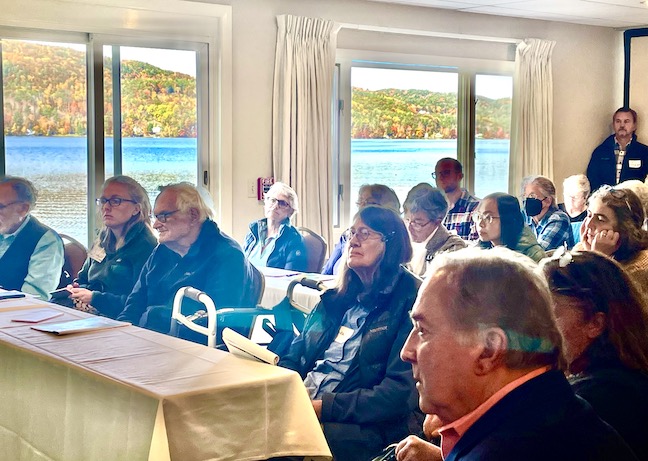
Thanks to all members of the conservation community that joined us for our 2025 Virtual Summit and Annual Meeting on Wednesday, September 10th. This year’s meeting featured over 50 AVCC members representing nearly 30 conservation commissions from across Vermont. We were greatly enthused by the turnout and pleased to have this opportunity to talk to and receive feedback from our members, supporters and friends. A special thanks goes out to our three CC presenters – Sue Stasny of Monkton, Jamie Kurowski of Cambridge, and Mark Naud of South Hero – as well as our two partner presenters – Jim Arbruster with the Vermont Institute of Natural Science (VINS) and Kevin Tolan with the Vermont Center for Ecostudies (VCE) – for their contributions. The full agenda and recording of the 2025 Annual Meeting can be found below.
12:00 pm:Introduction and Board Business Programming Update and Agenda Rundown: Bill Dell’Isola, Board Chair Membership/Financial Update: Mead Binhammer, Board Treasurer Board Elections: Marian Wolz, Board Secretary Proposed Bylaw Changes: Bill Dell’Isola, Board Chair
12:15 pm: Monkton Conservation Commission Sue Stasny, Co-Chair, shared the commission’s work to assemble and circulate birdwatching kits through the Russell Memorial Library, reducing the hobby’s barrier of entry for lower-income residents and spreading awareness and appreciation for the diversity of bird species in Addison County.
12:25 pm: Cambridge Conservation Commission Cambridge’s Jamie Kurowski presented the commission’s efforts to expand and deepen community engagement and outreach, specifically with its “BYOCutlery” incentive program at the Jeffersonville Farmers Market and “Welcome to Cambridge” packet for new residents.
12:35 pm: South Hero Conservation Commission Mark Naud, Chair, talked about the commission’s American Kestrel project, which included an educational presentation from a VINS naturalist and the construction and installation of nesting boxes throughout town. Read the “Success Story” here.
1:00 pm: Vermont Center for Ecostudies (VCE) Kevin Tolan, Staff Biologist, spoke about VCE’s Vernal Pool Atlas, and how CCs can plug into the effort to identify and monitor the health of these unique wetland ecosystems.
1:15 pm: Closing Remarks and Member Feedback
All conservation commission members who attend the meeting were automatically entered into a drawing to win an AVCC t-shirt. Congratulations to our winner, Karen McKnight of the Underhill Conservation Commission!
The Vermont Conservation Plan (VCP) Regional Listening Sessions were the first round of public engagement following the release of the Phase 1 Inventory Report, an inventory of conserved land and conservation policies around the state. These sessions consisted of an overview of the VCP guiding legislation, timeline, goals, and work to date, as well as updates from the Agency of Natural Resources and the American Farmland Trust. In order to gather as much public input as possible, these sessions were hosted at four locations across the state – Ludlow (7/23), South Burlington (7/24), East Burke (7/29), and Brandon (7/30) – with a virtual session held on August 5th for those that couldn’t attend in person. Learn more below or at the VCP website, https://lab2.future-iq.com/vcp/.
The draft objectives and pathways that create the proposed framework for the Vermont Conservation Plan are listed below. These materials, as well as a number of conservation project success stories, can be found at https://lab2.future-iq.com/vcp/summer25-rls-materials/.
Objective One: Support Conservation in Communities
Objective Two: Center Vermont Conservation Design
Objective Three: Strengthen Conservation Capacity
The Community Resilience and Biodiversity Protection Act, also known as Act 59 or the “30×30” bill, was passed in June 2023. To catch up on all the work completed to date, check out the Phase 1 Inventory Report. Additional information can be found in the Annexes (analyses, notes, and recommendations from the community) and Working Group Reports (deeper reviews of focal topics, including the management of state lands, aquatic systems, agricultural lands, and conservation categories).
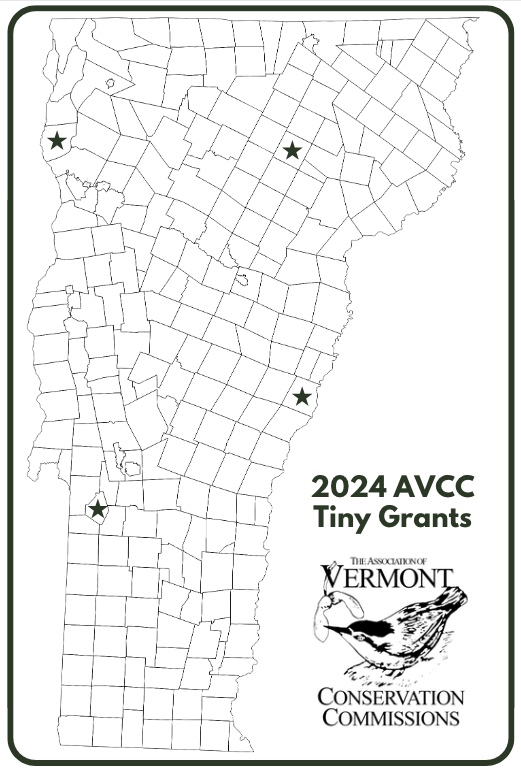
The Association of Vermont Conservation Commissions (AVCC) is pleased to announce the recipients of our 2025 Tiny Grants. This annual initiative provides seed money or matching funds to conservation commissions for specific land conservation, education and outreach, stewardship and management, and planning activities.
This spring, we received a record 31 applications for nearly $20,000 in combined funding, a reflection of both the vitality of Vermont’s many conservation commissions as well as the need for better resourcing and support. This year, we are proud to award over $4,000 – more than double our 2024 total – to eight commissions across four counties. These grants are made possible with generous support from The Nature Conservancy in Vermont, Two Rivers-Ottauquechee Regional Commission and Vermont Natural Resources Council.
We received applications from commissions across the state for a wide variety of conservation-related projects, including work to improve signage and repair trails on municipal lands, document wildlife activity with trail cameras, eradicate invasive plants and insects, and complete natural resource mapping, inventories and assessments. After much deliberation, the AVCC Board elected to fund projects from Bolton, Cambridge, Fayston, Johnson, Monkton, New Haven, Starksboro and Westford. Here are some more details about these projects:
Bolton – Joiner Brook Plantings Funding to reestablish native plant species at a former parking area at the bottom of Bolton Valley Access Road, restoring a buffer and promoting flood resilience along Joiner Brook, a tributary of the Winooski River.
Cambridge – Expanding Community Engagement Around Conservation Funding to expand CCC’s community outreach beyond their existing communication channels, bridging the gap between digital and in-person engagement and ensuring all residents have opportunities to shape conservation efforts. Part of this effort included the design, printing and distribution of a “Welcome to Cambridge” brochure for new residents and a “BYOCutlery” incentive program at the Jeffersonville Farmers Market.
Fayston – Boyce Hill Town Forest Documentary Funding to produce a documentary about the history of Boyce Hill, a 93-acre property that was donated and preserved via conservation easement. The documentary will help communicate to residents about management goals for the property and engage volunteers for future land management.
Johnson – Johnson Pollinator Garden Funding to enhance a nascent pollinator and native wildflower garden on an unused, unkept parcel of town-owned land adjacent to a skate park, community garden, and mobile home park. The garden will serve as a learning-lab to help educate the community about the value of flood resiliency projects.
Monkton – Birdwatching Kit Lending Library Funding to purchase three birdwatching kits for residents to borrow from Monkton’s Russell Memorial Library, enabling Monkton residents to develop an appreciation for nature via direct experience.
MCC Co-Chair Sue Stasny shows off the town’s new birdwatching kits at the annual Strawberry Festival, held at the Russell Memorial Library in June 2025
New Haven – Trail Camera Lending Library Program Funding to purchase two trail cams and accessories for residents to borrow from the New Haven Community Library. In addition to engaging community members to learn about, document, and better steward wildlife, the project aims to collect essential data that’ll help the town’s planning commission make informed decisions about land use. In addition to written instructions in the kits, the New Haven CC put together the following tutorial on how to deploy the trail cams for best results: https://youtu.be/eE4uDxKqoC4
Clipping from the Addison Independent detailing the NHCC’s work documenting wildlife travel with trail cams
Starksboro – Cota Conserved Lands Invasives Project Funding to purchase two specialized Extractigator tools for invasive species removal in the riparian areas along Lewis Creek. These tools will help the commission pursue its educational and community engagement goals, giving volunteers hands-on conservation experience.
Westford – Westford Trail Enhancement Project Funding to purchase lumber and hardware for the construction of two essential 8’ x 3’ bridges each in the Misty Meadows and Maple Shade trail networks to increase trail accessibility and mitigate environmental degradation in the face of worsening weather.
A volunteer’s tractor (Joel Fay, WCC member) hauls lumber to the construction site, about 1/2 mile from the Westford School parking lot where visitors can access the Misty Meadows Town Forest. Photo credit: Elias Rosenblatt (WCC member).
Excitingly, three of these CCs—New Haven, Starksboro, and Westford—are receiving their first Tiny Grant since at least 2016, and each is also a new AVCC member. We are excited to contribute to the important community-based conservation work these commissions have been doing for years.
The AVCC again extends its congratulations to all of the 2025 Tiny Grant award recipients and looks forward to seeing the positive impact these projects have on their communities. We also want to thank the commissions whose proposals we did not fund; it was heartening to read about all the innovative projects being planned and executed by hardworking volunteers across Vermont.
Your donation goes a long way in supporting local conservation. In 2024, our Tiny Grants program accounted for nearly 74% of our total spending, which means most of your contribution goes directly to the community volunteers making a difference in cities and towns across Vermont!
Founded in 1990 and governed by an all-volunteer Board of Directors, the Association of Vermont Conservation Commissions (AVCC) is a 501(c)(3) nonprofit whose mission is to support Vermont’s existing conservation commissions and encourage the establishment of new ones. Our EIN is 03-0350552. All donations are tax-deductible.
You will receive an email acknowledgement from the AVCC Board of Directors (vtconservation@gmail.com), but please reach out should you need anything further. We greatly appreciate your support, and look forward to working with you on conservation projects in your town!
The Vermont Climate Council is in the process of updating the state’s Climate Action Plan, with a finalized plan due by July 1, 2025. This plan has a necessarily broad focus on cutting climate pollution and helping communities adapt and become more resilient in a warming world. On Wednesday, March 26, the AVCC and VECAN (the Vermont Energy and Climate Action Network) co-hosted a webinar to explore some of the ideas in play and how you (and your networks) can help shape the plan.
We were joined by the following members of the Vermont Climate Council who are helping to lead the pollution cutting, rural resilience, and agriculture and ecosystems pieces of this important work.: ➡ Jared Duval, Energy Action Network, member of a Vermont-based organization with expertise in energy and data analysis ➡ David Mears, member with expertise in the design and implementation of programs to increase resilience to and respond to natural disasters resulting from climate change (also the chair of the Northfield Conservation Commission) ➡ Johanna Miller, Vermont Natural Resources Council, member to represent a statewide environmental organization ➡ Jaiel Pulskamp, Kettle Song Farm, member to represent the farm and forest sector
The Vermont Climate Council is expected to release a draft version at the end of March, and has scheduled public engagement opportunities throughout April in towns across Vermont (see below). Please follow this link to view the full list of priority recommendations from the Council’s subcommittees (please note that the Climate Council has not yet reached consensus on these actions).
Contact anr.cao@vermont.gov or call (802) 404-2729 with any questions, including for any accessibility needs (language, transportation, disability, etc.) to participate in the spring input sessions.
You can also view upcoming meetings of the Council and its various subcommittees on the calendar on their website. Vermonters are encouraged to join these meetings to share their thoughts with the Council, or submit a written comment here.